

Horizon Europe Sister Projects Discuss Data-Driven Tools for Sustainable Agriculture
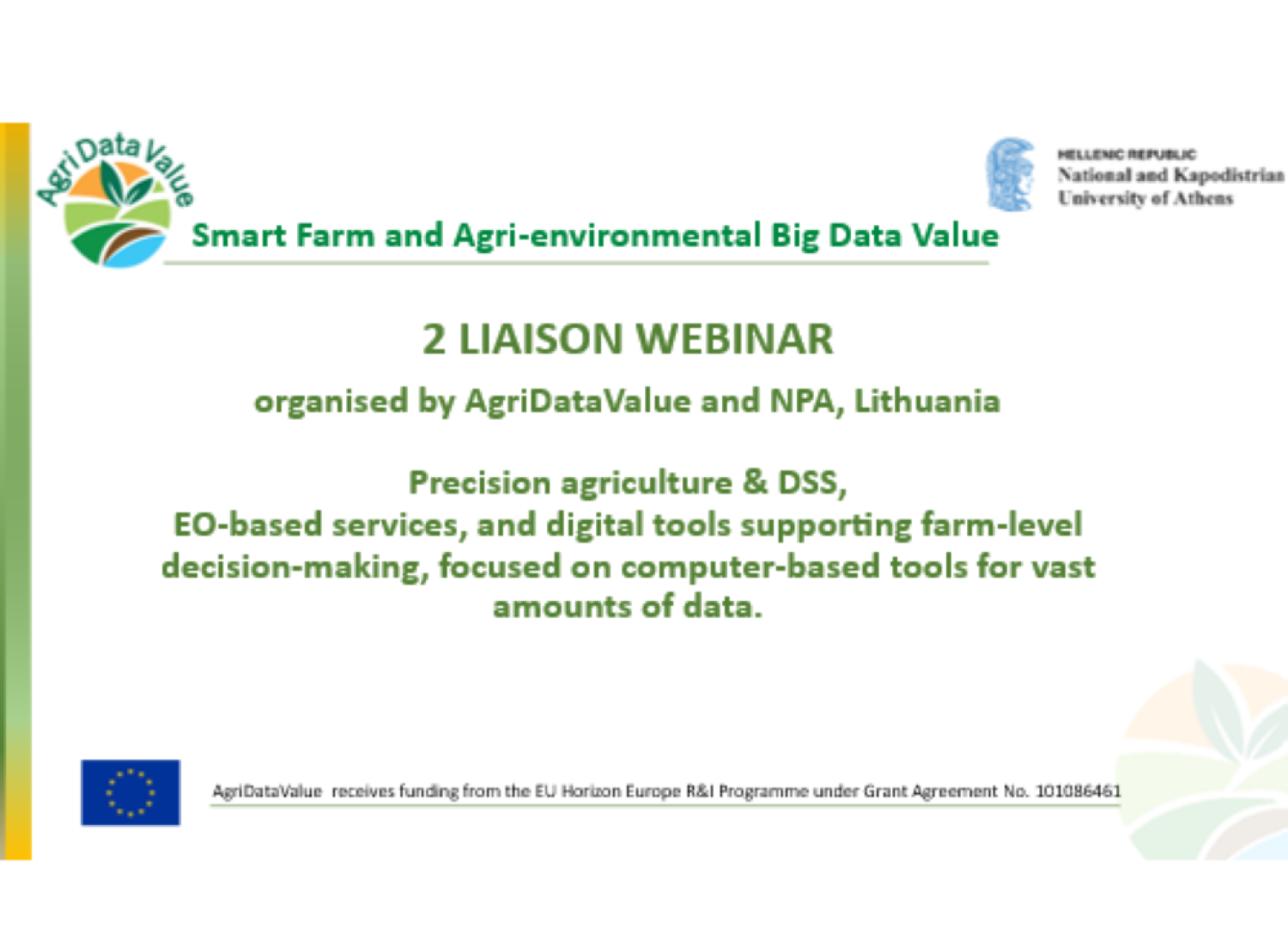
The second Liaison Webinar for Horizon Europe (HE) sister projects, organised by HE project AgriDataValue and the National Paying Agency under the Ministry of Agriculture of Lithuania, brought together European initiatives working on digital agriculture, Earth Observation, decision support systems, data sharing, and sustainable food systems. The webinar proved to be of real value for knowledge exchange, engagement and discussion.
The webinar focused on how agricultural and environmental data can be transformed into practical, trusted, and actionable recommendations for farmers, advisors, public authorities, value chain actors, and consumers. Opening the event, its moderator Ioannis Oikonomidis highlighted the growing importance of precision agriculture, decision support systems, Earth Observation-based services, and computer-based tools capable of processing large datasets. He noted that these tools can help farmers manage crops, optimise water and fertiliser use, predict disease risks, and improve both profitability and sustainability.
The event began with short presentations from participating sister projects, each offering a different perspective on the digital transformation of agriculture and rural areas. Tamara Popovic from SQAT project presented its work on smart soil mapping, combining Copernicus satellite data, soil sensors, robotics, and field-based laboratory analysis to support applications such as variable rate liming, fertilisation, seeding, tillage, and carbon farming.
Coordinator of the AgriDataValue project Dr. Theodore Zahariadis introduced the audience to the project‘s federated “platform of platforms”, which aims to collect, process, combine, and analyse agri-environmental data from different sources without requiring all data to be centralised. The project addresses several key barriers, including fragmented datasets, limited willingness to share data, lack of interoperability, insufficient processing capacity, and low trust in AI-generated advice. Its approach combines distributed data processing, edge-cloud technologies, blockchain-based incentives, federated learning, and explainable AI.
The HE project GUARDIANS project focused on the digitalisation of small and medium-sized farms. Emilio Terenes in the project presentation underlined that smaller farms often face greater barriers to adopting technology than large farms, even though they play a crucial role in rural economies, biodiversity, and territorial management. The project works with cooperatives, rural living labs; it comprises respective pilots, invites to open calls to test practical digital solutions and to support innovation pathways that are adapted to the realities of small farms.
The webinar also connected farm-level technologies with wider food system transformation. Freya De Keyzer from the HE project CUES presented its work on sustainable food choices, consumer understanding, transparency, and policy dialogue. The project looks at how consumers, food value chain actors, and policymakers can work together to support more sustainable food systems. This perspective added an important societal dimension to the webinar, showing that digital agriculture is not only about farm optimisation, but also about how sustainability information is communicated and understood.
Representative of the HE project DIGI4LIVE Jarkko Niemi highlighted the potential of digital data-driven solutions for livestock tracking, animal health and welfare, sustainability information, policy monitoring, and digital product passports. He stressed the need for better data harmonisation, standardisation, and interoperability to make livestock data more useful across farms, value chains, and public administrations.
Markéta Kollerová representing the HE project PoliruralPlus familiarised the online participants with the work on GeoAI for rural development. The project explores how geospatial data, Earth Observation, local knowledge, and artificial intelligence can support better territorial decisions. presented its tools which aim to translate complex spatial datasets into decision-ready insights for farmers, advisors, regions, and paying agencies. A key message from the presentation was that rural areas often do not lack data; rather, they lack actionable insight.
Raffaele Catoni who presented HE project TEAPOTS, introduced the online audience to an integrated physical and digital solution for converting agricultural waste into renewable energy, heat, biochar, and compost. Its digital platform uses data from farms, machinery, satellites, sensors, and weather sources to support planning and decision-making. The project demonstrates how digital tools can also contribute to circular economy models by helping agri-food actors manage waste, reduce costs, and improve soil quality.
A central discussion theme was how to move from data to decisions. Participants agreed that data collection alone is not enough. Decision support systems must produce recommendations that are understandable, relevant, and usable in real farming conditions. Trust in AI was identified as one of the main challenges. Farmers may be reluctant to accept advice from systems they do not understand, especially when recommendations come from sources outside their usual advisory network. Explainable AI, transparent reasoning, traceability, and validation in local conditions were therefore highlighted as essential.
Interoperability and standardisation were also discussed as key requirements for scaling digital agriculture. Farms already generate data through sensors, machinery, platforms, satellites, and administrative systems, but these sources often remain fragmented. Participants noted that better standards and more interoperable tools are needed to connect systems and ensure that decision support tools can rely on robust input data.
Adoption was another important topic. Digital tools must demonstrate clear added value, especially for smaller farms with limited investment capacity. Participants pointed to practical demonstrations, test-before-invest approaches, peer-to-peer learning, trusted intermediaries such as cooperatives, and user-friendly design as ways to build confidence and encourage uptake.
The final part of the discussion looked beyond the farm. Several speakers stressed that sustainability data should also be meaningful for consumers and society. Technical environmental indicators need to be translated into clear and accessible information about products, production methods, and sustainable choices. In this way, digital tools can help strengthen the connection between farmers, value chains, consumers, and policy objectives.
The webinar concluded with the introduction by the representative of the AgriData Partnership, SergioCinnirella, who underlined the importance of continued cooperation among sister projects. Participants discussed the importance of cross-linking outputs, sharing dissemination activities, strengthening synergies, and continuing coordination with wider European initiatives.
Overall, the HE sister projects second Liaison Webinar showed that the European digital agriculture projects are working toward a shared goal: transforming data into trusted, actionable, and sustainable decisions. By bringing together complementary perspectives on soils, crops, livestock, rural development, circular economy, consumer behaviour, and data governance, the event demonstrated the value of collaboration in shaping the future of smart and sustainable agriculture.
Last updated: 04-06-2026
Related news:
OASIS Implementation: Practical Use of EO data and AI solutions in Lithuania
NPA, Lithuania, showcases Its AI achievements at Panta Rhei Conference in Dublin
Mid-Term AgriDataValue Review: Reflecting on Three Years of Progress and Looking Ahead
Strengthening Agricultural Monitoring through Innovation and Cooperation: JRC FIRE Workshop